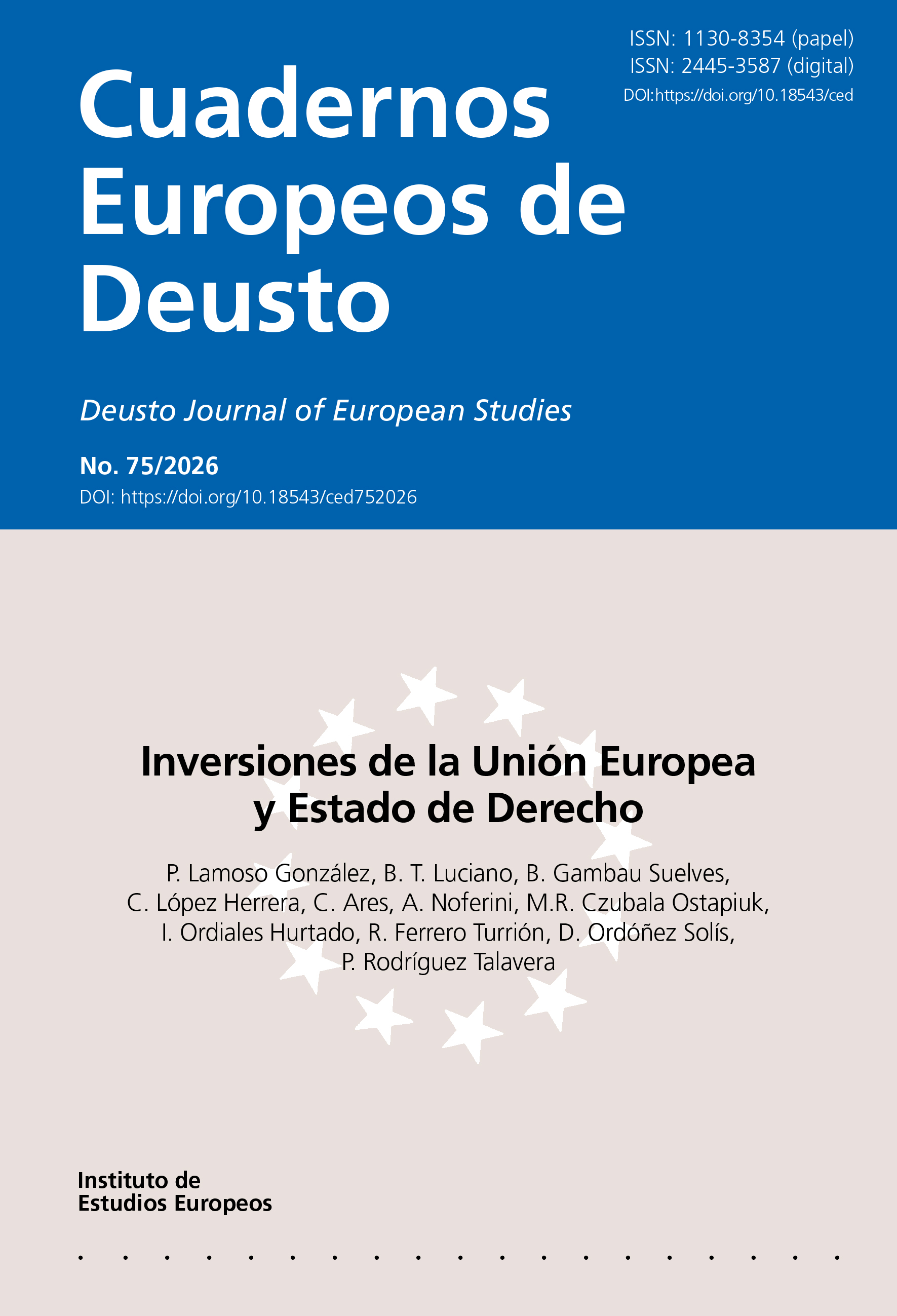
Actualidad institucional y económica de España en el marco de la Unión Europea (julio de 2026)
Abstract
During the first half of 2026, the European Union has continued to adapt its integration process to an environment shaped by the war in Ukraine, instability in the Middle East, trade tensions and weak economic growth. The Cypriot Presidency of the Council has focused its agenda on European autonomy, understood as a stronger capacity to ensure security, protect external borders, reinforce industrial capabilities and finance common priorities. The semester has not been defined by a single major reform, but by the implementation and consolidation of instruments agreed in previous years. At the institutional level, the Union has strengthened its financial and military support for Ukraine, advanced the coordination of the European defence industry and started applying the Pact on Migration and Asylum. The enlargement process has also progressed, particularly regarding Ukraine, Moldova and Montenegro. At the same time, negotiations on the 2028-2034 Multiannual Financial Framework have exposed the difficulty of reconciling agriculture and cohesion with emerging needs in defence, competitiveness, innovation and enlargement. Progress in the single market, customs reform and regulatory simplification has reflected an integration process increasingly focused on implementation and administrative capacity. Economic conditions have deteriorated as a result of a new energy shock linked to the conflict in the Middle East. Higher oil and gas prices have weakened growth forecasts, triggered a renewed increase in inflation and led the European Central Bank to raise interest rates in June. Although employment has remained relatively resilient, consumption, investment and exports have lost momentum. Fiscal policy has had to combine debt sustainability with higher expenditure on defence, energy and infrastructure, while the Recovery and Resilience Facility has entered its final stage. The semester has confirmed that the Union has developed a stronger common capacity to respond to crises, but it remains constrained by political fragmentation, limited shared financial resources and persistent economic differences among Member States.
Downloads

This work is licensed under a Creative Commons Attribution-NonCommercial-NoDerivatives 4.0 International License.
Last update: 26/10/2026
The authors are advised to read their rights carefully. We believe this approach ensures a fair agreement for both parties. These instructions should be read in conjunction with the Ethical Guidelines and the Open Access Policy, Licensing Terms and Copyright of the journal "Deusto Journal of European Studies (DJES)".
1. Authorship and Ethics
By submitting their manuscripts to Deusto Journal of European Studies (DJES), the authors accept and undertake to comply with the conditions of publication without the need to sign an additional transfer agreement with the Publisher (University of Deusto). In doing so, they guarantee that their work is unpublished in any form, original, and does not breach DJES’s Ethical Guidelines or the rights of third parties, and that no licences have been or will be granted that are incompatible with the rights granted to the Publisher.
The authors assume full and exclusive responsibility for the content of the study and formally declare that they have no conflicts of interest that affect the integrity of the research.
2. Publisher’s Rights
By submitting the manuscript, the authors agree to its publication under the Creative Commons CC BY-NC-ND 4.0 licence. Consequently, they grant the Publisher the exclusive, royalty-free and worldwide right of first publication, editing, layout and exploitation of the article. This grant authorises the Publisher to distribute, sub-license and index the work in any format, medium, database or institutional repository, for the purposes of promotion and scientific dissemination.
3. Copyright
The authors retain the intellectual property rights to their article and retain the right to distribute and use their work for teaching purposes, future research or personal archiving, provided that the original publication in the Journal is cited. They are also permitted to republish in other media, provided that a (foot)note is included with the full reference to DJES (including the DOI, where available) and no explicit endorsement of the Journal and/or Publisher is implied.
4. Open access
DJES is an open-access journal; this means that it is freely and fully accessible in its entirety immediately upon publication of its content. However, in accordance with the licence mentioned above, the authors of the articles must always be properly cited; and both commercial use and any modification intended for distribution will require the express prior written permission of the rights holder.
More details are available under the section “Open Access Policy, Licensing Terms and Copyright”.