Introduction. Human rights in the digital age: the European challenge
Abstract
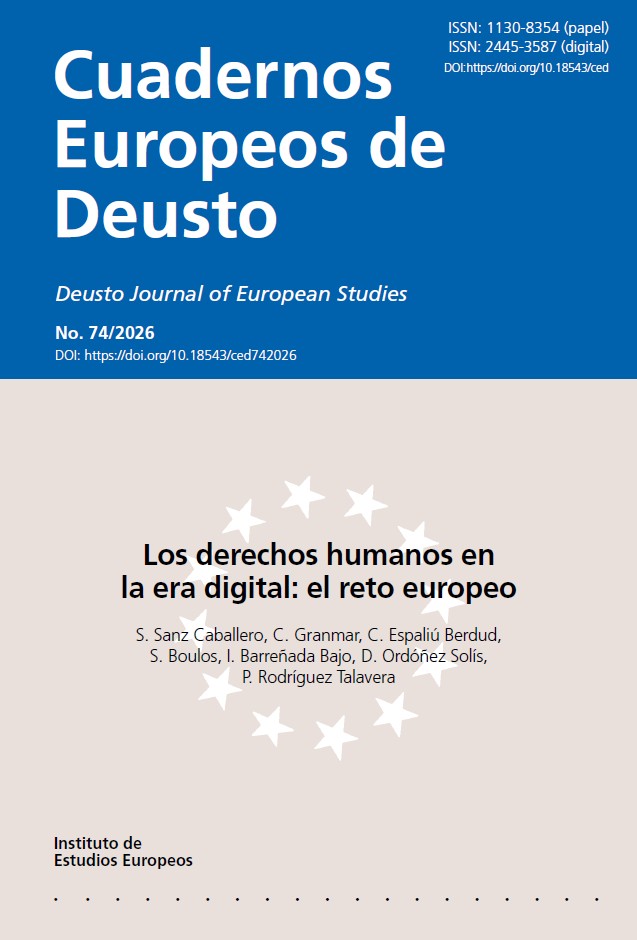
The contemporary liberal democratic order is currently navigating a period of profound introspection and external pressure, characterized by a systemic challenge to the core values that define the European project. This special issue of the prestigious journal Cuadernos Europeos de Deusto, which is widely recognized as one of the best and most influential specialized publications for European studies and legal questions, brings together a collection of scholarly works that explore the precarious balance between internal institutional resilience and the growing threat of foreign interference and normative inconsistency. The research presented here is the result of a significant academic partnership between the Tomas Moro Observatory of International Relations at the Universidad CEU Fernando III in Seville and the Las Casas Institute, Blackfriars Hall, University of Oxford. The insights contained in this volume were meticulously developed through two specialized online seminars held in May 2025 and November 2025 respectively, providing a rigorous forum for the multidisciplinary analysis of the new security situation facing the European Union and the broader global order. These seminars served as a critical platform for technical review and debate prior to the submission of the final articles. The results underscore the vital need for an interdisciplinary approach to address the complex challenges that digitalization and current geopolitical crises pose to the European legal and political system, particularly regarding the protection of human rights. This publication posits that the rule of law, democracy, and human rights form an inseparable triangle where the absence or erosion of any single element renders the entire constitutional framework ineffective. In the European context, these are not merely abstract principles but represent the very DNA of the Union. However, as the following contributions demonstrate, this interdependent triangle is under significant strain. We see a dual reality where the Union is pioneering sophisticated legal frameworks to protect its digital and judicial integrity while simultaneously struggling to maintain the credibility of its normative claims on the world stage.
Downloads
Copyright (c) 2026 University of Deusto

This work is licensed under a Creative Commons Attribution-NonCommercial 4.0 International License.
The author grants to the Publisher the distribution, public communication, and reproduction rights of her/his work subject of publication in Deusto Journal of European Studies (DJES), whichever the media may be, including the permission to include it in the databases where this Journal is indexed and in the institutional repository of the Universidad de Deusto.
Upon its publication, the content of any Issue of Deusto Journal of European Studies (DJES) can be accessed, read, downloaded, copies, and distributed freely for non-commercial purposes and in accordance with any applicable copyright legislation.
The content of Deusto Journal of European Studies (DJES) can be subsequently published in other media or journals, as long as the author clearly indicates in the first footnote that the work was published in Deusto Journal of European Studies (DJES) for the first time, indicating the Issue number, year, pages, and DOI (if applicable). Any other use of its content in any medium or format, now known or developed in the future, requires prior written permission of the copyright holder.
The content of the work published in Deusto Journal of European Studies (DJES) is each author's sole responsibility. The authors assume the responsibility of obtaining all the necessary licenses for the reproduction in their manuscripts of any text, material or illustration coming from another author, institution or publication. The liabilities that may arise from complaints for publishing plagiarised articles are the sole responsibility of the author.
3.jpg)
2.jpg)
2.jpg)
2.jpg)
2.jpg)
2.jpg)